
Let’s start with the bottom line: patching is dead as a strategy. Even though teams have gotten dramatically better at it - supercharged by automated remediation and agents - attackers simply move faster than anyone can keep up. The backlog refills faster than you can drain it, and attackers get to the flaw before your patch does.
In this post we break down what's happening, and how teams can actually defend against it without running a race they can't win.
"As defenders, you need to look at your watch, not a calendar."
George Kurtz, CrowdStrike
AI is finding flaws faster than any team can fix them
Every security team carries a quiet debt: issues nobody had time to fix (or that keep reopening), stale permissions granted years ago, and forgotten access paths that nobody uses and no one knew to remove. For years that was a manageable thing to carry, because finding the weak spots took attackers real time and effort.
AI just called the debt in. It reads everything you run, around the clock, finds the flaws, and works out how to exploit them at a pace no team can match.
This month's clearest example is php2shell, two critical flaws in PHP, which runs a huge part of the web. They let an attacker run code on a server over the network with no login. These flaws dated back more than a decade and sat in the pile like any other bug, until AI-assisted research showed how exploitable it really was. So you have something that waited years on a backlog and then turned dangerous almost overnight, and exploitation attempts were being reported in the wild as soon as the news broke.
It's only going to get worse, because the models keep improving. Which is why a "zero criticals" list no longer means what it used to. That goal assumed the list had an end. When almost anything you run can turn out to be exploitable, and AI can find it faster than your team can remediate it, the list doesn't end. It refills.
Patch Tuesday shows how fast the pile is growing
Microsoft's Patch Tuesday is the clearest picture of it. In July, Microsoft shipped a record 570 fixes. August was 400, September came close to 1,000, and on October 13 it reached 1,411, with 70 rated critical and three zero-days.
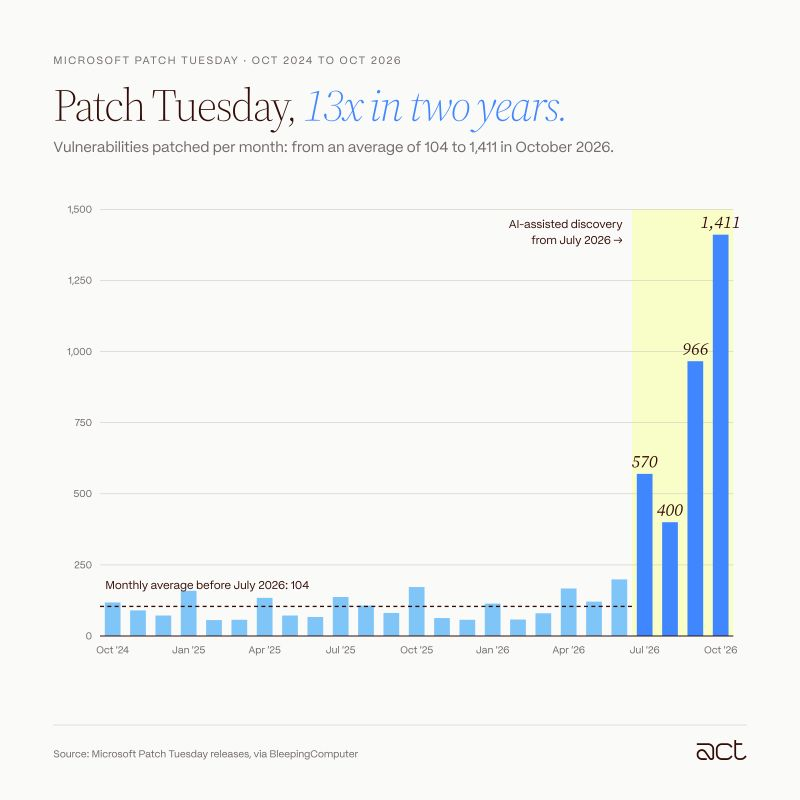
Microsoft isn't treating that as a blip. In its own note on Patch Tuesday, it says AI models are helping accelerate discovery and that it expects releases "to continue trending larger for some time." Picture whoever owns patching at a normal company on the morning of a release like that. Over a thousand fixes to test and roll out, a patching schedule that was already overloaded, and the next batch already on its way.
Attackers are exploiting them faster than you can patch
The pile-up is only half the problem. The other half is timing. Attackers are finding these flaws and using them faster than any patch process can respond, and that includes automated and agentic remediation. Those tools are a real improvement. They will make your team faster at rolling fixes out. But no patching speed fixes a zero day. By definition, nobody knows it exists until it's already being exploited, so there is no patch to apply. That makes "patch faster" officially irrelevant in an era where AI finds the flaws before we do.
Look at ZeroDayClock's data: 87% of the vulnerabilities exploited so far in 2026 were exploited on or before the day they were disclosed. In 2018, that figure was about 19%.
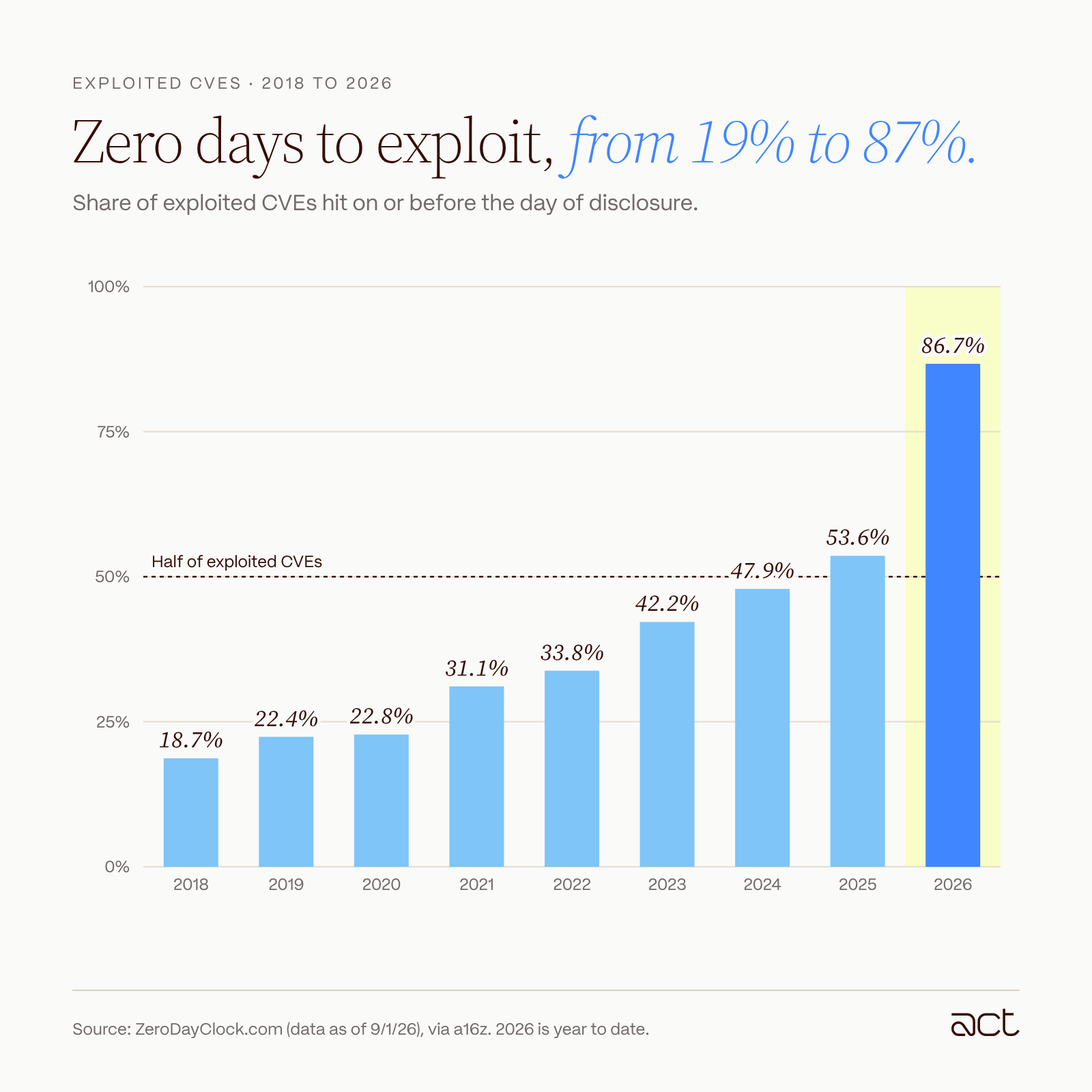
Read what that means for a defender. For most of what's now being used against organizations, the first day you hear about a flaw is the day it's already being exploited. There is no gap between "we found out" and "someone is using it" for any patching, manual or automated, to fit inside. You can't speed up a step that has already been skipped. So for a growing share of what gets exploited, patching can't be the control that saves you. It arrives after the attack, or at best alongside it.
Build the controls at the foundation, so a zero day has nothing to reach
So what do you do instead? You stop trying to win the race and change what happens when you lose it. An exploit buys an attacker one thing: an entry point. What happens next depends entirely on what they can reach from there. The role attached to the machine they landed on, the network segments it sits in, the databases and buckets and other systems it's allowed to talk to. Most of that reach was granted for a reason that made sense once, but today the vast majority of it is never used. It just sits there as an open road for attackers to travel through.
So instead of trying to patch faster than AI, put the controls in place at the infrastructure layer. That way, when an attacker does manage to get in, they have nowhere to go and nothing to reach.
That’s exactly what we do at Act. Instead of surfacing risk, we remove it at the source.
We place contextual boundaries across your cloud, clearing out accumulated debt and keeping new debt from piling back up. With a single architectural change, teams can eliminate entire categories of risk and shut down thousands of unneeded attack paths at once.
The result? Your team stops chasing alerts, your attack surface shrinks, even as attacks run at machine speed, and your business is free to adopt AI, safely.